

What Does It Really Take to Get Your Food or Drink Product Onboard a Ferry?
posted 17th September 2026
For many food and drink brands, travel means airlines, trains or airport lounges. But ferries represent another major opportunity, with thousands of passengers interacting with food and beverage products while travelling across the UK and Europe.
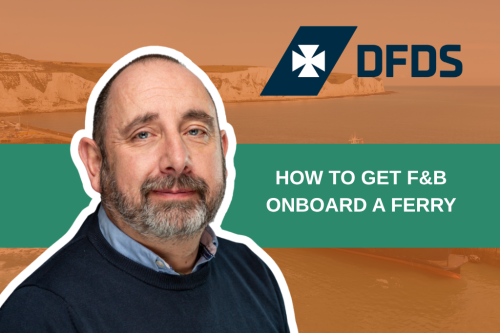
TickEat recently spoke with Dave Lewis, Head of Food, Beverage and Hotel Functions at DFDS, to find out how F&B works across the ferry network, what he looks for in suppliers, and what brands need to understand before trying to break into the channel.
One thing became clear very quickly: there is no single formula for ferry F&B. The right product for a 90-minute crossing could be completely wrong for a 16-hour overnight journey.
Food is a major part of the passenger experience
DFDS is much more than a passenger ferry operator, with a large part of the wider business focused on logistics. But within its ferry operation, food plays an important role in why passengers choose to travel with DFDS.
According to Dave, after destination, journey time and price, food is the fourth biggest reason passengers choose DFDS. That means F&B has a significant role to play in the overall passenger experience, with quality, provenance and consistency all key.
Rather than competing purely on price, the aim is to make the food experience another reason for passengers to come back.
Different routes mean different opportunities
One of the biggest mistakes suppliers can make is assuming every ferry works in the same way.
Even short crossings can have completely different F&B requirements depending on the passenger demographic, route, galley facilities and service style. One route may suit hot handheld or grab-and-go products, while another may focus more heavily on familiar sit-down dishes.
On longer journeys, such as Amsterdam to Newcastle, the experience changes again. With passengers onboard overnight, there is more opportunity for buffets, restaurants and premium dining.
For suppliers, the key takeaway is simple: you are not just pitching a product to DFDS, you are pitching it for a specific passenger, route, outlet and operational environment.
Familiarity still matters
Innovation is important, but travel is often a comfort-led occasion.
On busy short crossings, passengers have a limited amount of time to decide what they want. Dave therefore looks for what he describes as “established trends with a twist” - products that feel familiar enough to understand quickly, but still bring something different.
There is a reason full English breakfasts and fish and chips remain among DFDS’ strongest sellers. Passengers often gravitate towards products they already know, particularly when travelling. For innovative brands, that means asking a simple question: can the passenger understand what your product is and why they want it within seconds?
A great product is only half the battle
Operational readiness matters just as much as taste or branding.
Alcohol is a good example. Because much of DFDS’ onboard operation is duty free, alcoholic products need to move through the appropriate bonded supply chain. A brand might have an outstanding product, but if it cannot reach the ship through the correct route to market, listing it becomes significantly harder.
The same applies to food. On the Channel operation, DFDS can run 52 crossings a day, with vessels carrying up to around 1,000 passengers. Ships can have incredibly tight turnaround windows, meaning deliveries need to work through established supply chains rather than arriving independently.
For smaller brands, this does not necessarily mean the door is closed. DFDS uses nominated lines through its distribution partners, allowing smaller suppliers to enter the system where the product meets the required standards. In some cases, products initially introduced for DFDS have even gone on to be picked up by the distributor for other customers.
Small brands can still win
Being a household name is not always an advantage.
Dave spoke about the importance of working with suppliers who genuinely know and care about their products.
“I buy from people.”
For him, passion, product knowledge and a strong working relationship matter. DFDS has worked with very small suppliers and created nominated lines specifically to bring the right products onboard.
One example is PLAYin CHOC, which Dave first worked with when the business was still relatively small. It may not be the highest-volume product onboard, but it adds something distinctive to the passenger experience. That creates real opportunities for smaller brands with the right product and proposition.
Do your homework before pitching
One of the quickest ways to lose a buyer’s interest is to pitch something that simply cannot work operationally.
Dave regularly sees suppliers approach DFDS with products that might be great in a restaurant environment but are unsuitable for a ferry with hundreds of passengers, limited galley space and tight service windows. Commercial reality matters too. A product needs to work financially as well as operationally.
Before approaching a ferry operator, suppliers should understand where the product will be served, how quickly it needs to be prepared, what equipment is available, how it will reach the ship and what price point passengers will accept.
Consistency matters after the listing
Getting onboard is only the beginning. Once a supplier is listed, one of the biggest expectations is consistency. The product delivered to passengers needs to match the quality of the sample that originally won the business.
Dave was clear that sending an idealised sample that does not reflect the real-world product is a major red flag.
Onboard teams are also highly engaged with what works and what does not. Many crew members live onboard for two weeks at a time, meaning they quickly notice problems with quality, portioning or consistency.
Trials need to happen at the right time
Timing is another important factor. Dave prefers to run larger trials during busier periods such as Easter, when passenger numbers provide a clearer indication of whether a product can perform. If something works through Easter, there is then time to refine and establish it ahead of summer.
By peak summer, the operation needs stability rather than constant testing. For suppliers, understanding the buyer’s commercial calendar can therefore be just as important as understanding the menu.
Sometimes a great product simply doesn’t sell
One of the most useful insights from the conversation was Dave’s willingness to talk about products he personally liked that passengers simply did not buy.
After meeting one supplier through a TickEat event, DFDS trialled a protein snack as an impulse purchase near the till during a busy period. The product tasted good, the branding worked and the supplier was passionate, but sales did not follow.
The trial ended. It is a useful reminder that a buyer liking your product is not the same as passengers buying it.
However, Dave’s approach is to remain open and transparent with suppliers, sharing sales feedback and explaining why something has or has not worked. A first product might fail, but the next one could be the right fit.
Where are the opportunities?
Opportunities vary by route and outlet, but categories discussed included bakery, hot snacks, grab-and-go, beverages, pizza, pasta, salads, children’s products and impulse purchases.
Some areas are naturally harder to enter because DFDS already has established contracts, particularly where large-scale equipment or commercial partnerships are involved.
But even where similar products already exist, a new supplier can still have a chance if the product is significantly better, commercially viable and operationally right. For the right product, volumes can also be substantial, with some categories moving in the tens or hundreds of thousands of units.
The ferry opportunity is bigger than many brands realise
A ferry is not one F&B occasion. It can include cafés, restaurants, buffets, bars, grab-and-go, children’s offers and premium dining, sometimes within the same network.
That creates opportunities for businesses of very different sizes, but succeeding requires more than simply sending a buyer a sample. Brands need to understand the passenger, the route, the operation, the supply chain and the commercial reality behind the listing. That is where access to buyers early in the process can make a real difference.
Want to meet buyers like DFDS?
At TickEat, we connect ambitious food and drink brands directly with the people sourcing products across travel and leisure.
Through our Meet The Buyer events, sector-specific Buyer Dinners and our services, brands can meet decision-makers from ferry and cruise operators, airlines, rail, lounges, hospitality and the wider travel sector.
The aim is not simply to put suppliers in front of buyers, but to help brands understand what those buyers actually need so they can enter the conversation with a stronger product, proposition and route-to-market strategy.
Think your product could work onboard ferries or elsewhere in travel and leisure? Explore TickEat’s upcoming events and start the right conversations with the buyers shaping the sector.